DoorDash, Knowledge Systems Architect (Contract), 2024 to 2025
One governed knowledge system for six engineering teams
DoorDash IT documentation had grown across 25+ repositories with no owners. During live incidents, on-call engineers spent an average of 12 minutes finding the right runbook. I audited it, rebuilt it and handed over a system with owners and a review cycle.
The problem
Six teams (Incident Response, Security Engineering, Platform Engineering, SRE, Engineering Enablement and IT Operations) kept documentation in Confluence, Notion, Google Drive and GitHub, with no shared taxonomy and no owners.
On-call engineers took four times the 3-minute target to find a runbook mid-incident. Security gaps traced back to authentication guides that were missing or had never been tested.
What the audit found
- Runbooks spread across 25+ repositories with no single source of truth
- Okta and SAML guides missing or untested
- No onboarding path for new engineers
- Competing versions of the same procedure, with no owner
- Change management run out of Google Drive
What I built
A knowledge system built to be found at incident speed and to stay current after I left.
One source of truth
25+ repositories consolidated into a single Confluence-based system, with one template per content type.
A taxonomy with owners
Every content type got a standard template, a named owner and a review trigger.
Search tuned for incidents
Metadata, incident tags and five semantic search parameters, specified for the platform's AI-assisted ranking.
A 90-day review cycle
Ownership for 100% of content, automated review reminders and a deprecation rule, adopted by Engineering Enablement.
How the work ran
- Audit. Interviewed six teams, mapped 25+ repositories and scored each one on accuracy, ownership, freshness and findability.
- Architecture. Built one taxonomy and naming standard, ending six or more variant titles for the same procedure.
- Rebuild. Rewrote priority runbooks to one template with decision trees, escalation paths and rollback steps. Tested every Okta and SAML guide in a sandbox. Replaced three competing onboarding guides with one Golden Path.
- Search. Wrote the specification for five semantic search parameters and validated retrieval against queries drawn from real incidents until the 3-minute target was met.
- QA. Tested runbooks against incident simulations in staging and got security sign-off on every credential document.
- Handoff. Delivered the ownership matrix, the review cadence and a governance playbook, then walked Engineering Enablement through it as the owner.
Artifact
A self-directed sample that rebuilds the approach. The results above come from the contract role.
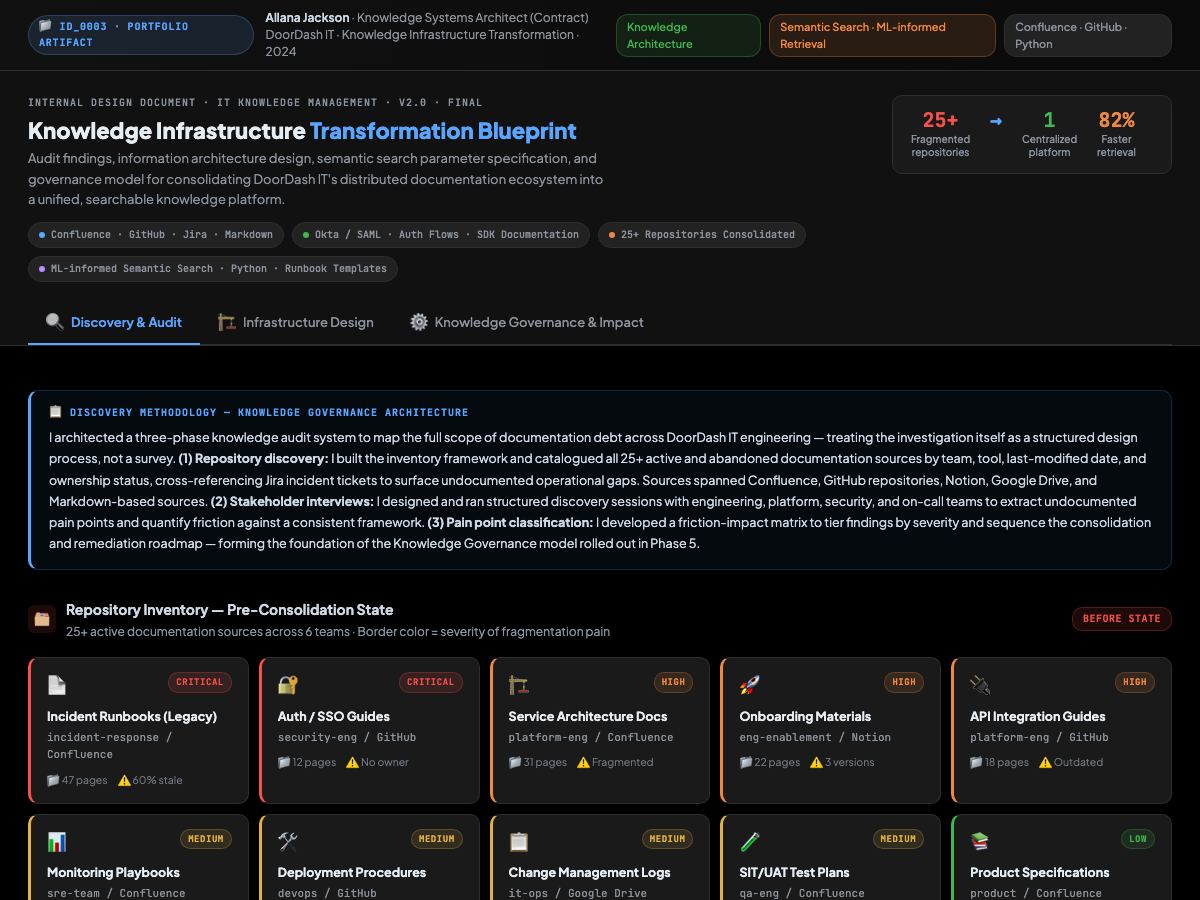
Self-directed sample
Knowledge infrastructure blueprint
The audit method, repository inventory, taxonomy, search specification, runbook templates and ownership model.
Next project
Domino's: NextGen Pulse POS rolloutRebuilding a help center or knowledge base?
Email Allana about a project